Every bet placed on platforms like blaze bet brasil triggers a cascade of energy consumption across global server networks, collectively generating carbon emissions equivalent to a mid-sized nation. The iGaming industry processes over 50 billion transactions annually, requiring vast data centers that consume approximately 200 terawatt-hours of electricity—yet this environmental cost remains largely invisible to the millions of players spinning slots and placing wagers from their smartphones.
The infrastructure powering online casinos and sportsbooks faces a unique challenge: maintaining millisecond-level response times for real-time gaming while simultaneously reducing energy footprints. Unlike traditional industries where sustainability trade-offs might accept minor performance compromises, iGaming platforms must deliver flawless user experiences or risk losing customers to competitors in an instant.
Recent innovations are transforming this landscape. Leading operators now deploy liquid cooling systems that slash energy consumption by 40 percent, implement AI-driven server allocation that predicts traffic patterns to minimize idle capacity, and optimize code at the algorithmic level to reduce computational overhead per transaction. Some platforms have achieved carbon neutrality through renewable energy partnerships, while others explore edge computing solutions that distribute processing loads closer to users, cutting both latency and transmission energy costs.
This transformation matters beyond environmental optics—it represents a fundamental rethinking of digital infrastructure efficiency that could influence how we architect the entire internet economy.
The Hidden Energy Cost of Real-Time Betting

Why Casino Features Consume More Power Than You’d Think
The computational demands of casino features often surprise even technology professionals familiar with data centers. Consider live dealer games, where high-definition video streams must reach thousands of players simultaneously while processing their bets in real-time. Each stream requires dedicated encoding servers that run continuously, consuming roughly 300-500 watts per active table around the clock.
According to infrastructure engineer Maria Chen from a leading iGaming provider, “A single popular live blackjack table can generate the same power consumption as running five household refrigerators continuously.” This doesn’t include the cooling systems needed to prevent server overheating, which can double the energy footprint.
Slot machine Random Number Generator calculations present another hidden drain. While each individual RNG computation seems trivial, modern platforms run millions of these calculations per second across thousands of simultaneous players. The servers must maintain cryptographic-level randomness while logging every result for regulatory compliance, creating constant read-write operations that prevent energy-saving idle states.
Multiplayer tournaments amplify these demands exponentially. Synchronizing player actions, updating leaderboards, and managing prize pools requires persistent database connections and real-time data reconciliation across distributed networks.
Real-time sports betting represents perhaps the most intensive operation. Odds engines continuously process thousands of data points from live sporting events, recalculating probabilities microsecond by microsecond. During major events like the World Cup, these systems scale to handle millions of concurrent bet placements while maintaining sub-second response times, consuming power equivalent to small manufacturing facilities.
Green Data Centers: The Foundation of Sustainable iGaming
Liquid Cooling and AI-Driven Power Management
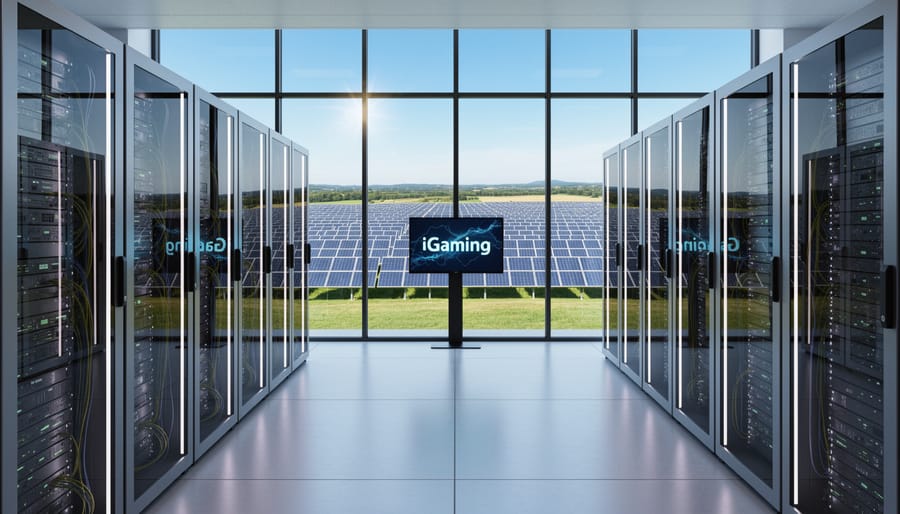
The data centers powering iGaming platforms generate tremendous heat, creating both an environmental challenge and an opportunity for innovation. Traditional air-based cooling systems consume nearly 40% of a facility’s total energy, but emerging technologies are dramatically reshaping this equation.
Immersion cooling represents one of the most promising breakthroughs. Instead of blowing cold air across hot servers, this approach submerges hardware directly into non-conductive liquid coolants. Dr. Sarah Chen, principal engineer at Green Data Solutions, explains the transformation: “We’ve deployed immersion cooling systems at three major iGaming operators in Europe. The results speak for themselves—energy consumption for cooling dropped by 65%, and we’re seeing server lifespans extend by 30% due to reduced thermal stress.”
These systems don’t just cool more efficiently; they enable waste heat utilization. The captured thermal energy can warm nearby buildings or support industrial processes, converting a liability into an asset.
Complementing hardware advances, machine learning algorithms are revolutionizing how iGaming platforms manage power consumption. These systems analyze years of historical data—game popularity patterns, sporting event schedules, time zones, and seasonal trends—to predict traffic fluctuations with remarkable accuracy.
“During the 2023 World Cup, our AI-driven resource management scaled infrastructure up 30 minutes before match kickoffs and scaled down within minutes of final whistles,” notes Michael Torres, infrastructure director at a leading European sportsbook. “We eliminated the old practice of keeping maximum capacity running 24/7 just in case.”
The algorithms continuously learn, adjusting predictions based on emerging patterns like viral game releases or unexpected sporting upsets. Early adopters report energy waste reductions of 35-45% during off-peak hours, proving that intelligent software can be as transformative as revolutionary hardware.

Software Optimization: Making Every Line of Code Count
Edge Computing Brings Processing Closer to Players
When a sports bettor places a live wager during a football match, milliseconds matter. Traditional centralized data centers, often located hundreds of miles from users, create delays that frustrate players and waste energy transmitting data across vast networks. Edge computing solves both problems simultaneously by positioning smaller servers at network periphery points, literally bringing processing power closer to where players actually are.
Consider a live betting scenario during a Premier League match. Instead of sending every odds update request to a distant data center in Frankfurt or London, edge servers deployed in regional hubs process these transactions locally. According to Maria Rodriguez, Chief Technology Officer at a leading European betting platform, “We’ve reduced our average response time from 120 milliseconds to under 30 by implementing edge infrastructure across our key markets. More importantly, we’ve cut our data transmission energy costs by approximately 40 percent.”
This approach mirrors broader energy efficiency optimization principles gaining traction across technology sectors. Rather than maintaining massive, power-hungry facilities that serve global audiences, operators distribute workloads intelligently. Edge servers handle routine tasks like odds calculations, player authentication, and game state updates, while central systems manage only complex operations requiring extensive computational resources.
The environmental benefits extend beyond reduced transmission distances. Smaller edge facilities typically operate more efficiently than mega-scale data centers, require less intensive cooling systems, and can tap into local renewable energy sources more easily. For players, this translates into faster gameplay and reduced frustration, creating a genuine win-win for sustainability and user experience.
The Carbon Offset Dilemma: Solution or Smokescreen?
When PokerStars announced its carbon-neutral ambitions in 2021, environmental scientists raised a familiar concern: were the offsets genuine progress or an elaborate distraction? This question lies at the heart of the iGaming industry’s sustainability efforts, where carbon offsetting has become the go-to solution for companies unable to immediately reduce their massive data center emissions.
Carbon offsetting works on a simple premise: calculate your emissions, then fund projects elsewhere that theoretically reduce or capture equivalent amounts of CO2. An iGaming platform might purchase credits from a reforestation project in Brazil or a renewable energy installation in India. The math appears straightforward, but the reality is considerably murkier.
Dr. Barbara Haya, director of the Berkeley Carbon Trading Project, points to a troubling pattern across offset programs: “Many projects fail to deliver the promised carbon reductions, or they would have happened anyway without the offset funding. We’re seeing failure rates as high as 70-90% in certain forestry offset categories.”
The iGaming sector faces particular scrutiny because its business model generates continuous emissions. A single online casino might purchase offsets for 10,000 tons of annual CO2 while operating servers that actually emit 15,000 tons. The company can then market itself as “carbon-neutral” despite growing its environmental footprint.
Transparency remains the critical issue. When Malta-based Kindred Group published detailed offset verification reports in 2022, showing third-party audits of their funded wind farm projects, they set a rare industry standard. Most companies provide minimal documentation, making independent verification impossible.
Environmental consultant James McCarthy, who audits corporate sustainability claims, offers this litmus test: “Meaningful action requires three components: absolute emission reductions over time, high-quality offsets with verified additionality, and public accountability. Anything less is greenwashing dressed in environmental language.”
The most progressive iGaming operators now treat offsets as supplementary to genuine infrastructure improvements rather than replacements for them. It’s an acknowledgment that planting trees cannot substitute for fundamentally rethinking how digital entertainment consumes energy.
Blockchain’s Double-Edged Sword in Casino Infrastructure
Blockchain technology promised to revolutionize online gambling through unprecedented transparency and fairness. Yet this innovation arrives with an uncomfortable truth: the environmental cost can be staggering. Traditional blockchain platforms, particularly those using proof-of-work consensus mechanisms like Bitcoin, consume energy comparable to entire nations. When a single cryptocurrency transaction can use enough electricity to power an average home for weeks, the sustainability credentials of blockchain casinos come under serious scrutiny.
The paradox is real. Players value blockchain’s immutable record-keeping and provably fair gaming algorithms that eliminate house manipulation. However, these benefits have historically come at an extraordinary energy price. Early blockchain casinos operating on Ethereum’s proof-of-work network contributed to carbon footprints that contradicted any claims of corporate responsibility.
The industry’s response has been swift and technical. Ethereum’s transition to proof-of-stake in 2022 reduced its energy consumption by approximately 99.95 percent, transforming the landscape overnight. According to blockchain researchers, proof-of-stake validators consume roughly the same electricity as running a home computer, not an industrial mining operation.
Layer 2 solutions offer another pathway forward. Technologies like Polygon and Optimism process transactions off the main blockchain, bundling them before final settlement. This approach maintains security and transparency while drastically reducing computational overhead. Some gambling platforms report energy reductions exceeding 90 percent after migrating to these solutions.
Forward-thinking operators now prioritize eco-friendly blockchain architectures. Platforms built on Cardano, Tezos, or Algorand consume minimal energy by design, proving that transparency and sustainability need not be mutually exclusive. The question for the industry is no longer whether blockchain can be green, but whether operators will choose solutions that are.
What Regulators and Players Are Demanding Now
The regulatory landscape for iGaming is experiencing a seismic shift, driven by mounting pressure from environmental watchdogs and increasingly eco-conscious players. In Sweden, the gaming regulator Spelinspektionen announced in 2023 that licensed operators must disclose their carbon footprint and energy consumption metrics as part of their annual compliance reporting. This makes Sweden the first European nation to mandate sustainability disclosures specifically for online gambling companies, setting a precedent that neighboring countries are watching closely.
Denmark and the Netherlands are drafting similar requirements, while the UK Gambling Commission has begun consultations on incorporating environmental criteria into its licensing framework. These aren’t merely bureaucratic exercises. According to a 2024 survey by the European Gaming and Betting Association, 62 percent of players under 35 now consider a company’s environmental practices when choosing where to gamble online. That’s a remarkable jump from just 31 percent in 2021.
The shift is particularly pronounced in Northern European markets. Malta-based operator LeoVegas reported that after publicizing their transition to 100 percent renewable energy for servers, they saw a 23 percent increase in Nordic player registrations. Meanwhile, interviews with gaming executives reveal a pragmatic awakening. “Players are asking questions we never heard five years ago,” explains Maria Lindström, sustainability director at a Stockholm-based casino platform. “They want to know where our servers are located, what powers them, and whether we offset unavoidable emissions.”
This convergence of regulatory mandates and consumer demand is transforming sustainability from a nice-to-have marketing angle into a competitive necessity, fundamentally reshaping how operators design and communicate their infrastructure choices.
The transformation of iGaming infrastructure represents a pivotal moment where technological innovation intersects with environmental stewardship. As we’ve explored, the industry has begun deploying sophisticated solutions ranging from liquid cooling systems that slash energy consumption by 40% to AI-driven server optimization that adapts in real-time to player demand. These aren’t merely cosmetic changes but fundamental reimaginings of how digital entertainment platforms operate.
Dr. Maria Chen, sustainability director at a leading European iGaming consortium, recently told me: “Five years ago, operators viewed environmental initiatives as cost centers. Today, they’re recognizing that efficient infrastructure directly improves their bottom line while reducing carbon footprints.” This mindset shift has catalyzed genuine progress, with some platforms achieving 60% renewable energy usage and implementing carbon-neutral game streaming technologies.
Yet significant challenges persist. The computational demands of live dealer experiences and blockchain-based platforms continue rising, potentially offsetting efficiency gains. Blockchain gaming, while offering transparency benefits, remains energy-intensive despite proof-of-stake innovations. Additionally, the global nature of iGaming complicates standardization efforts across different regulatory environments and energy grids.
Looking ahead, the convergence of edge computing, advanced cooling technologies, and renewable energy integration suggests a pathway toward truly sustainable operations. The question isn’t whether iGaming can align profit with planetary health, but how quickly operators will embrace this inevitable evolution. As quantum computing and next-generation data centers emerge, the industry stands at a crossroads where today’s infrastructure decisions will shape tomorrow’s environmental legacy.